


The Summer 2026 REU group, with Director of ICT, Professor Randall Hill
Long hours in the lab, hypotheses that don’t hold up, methods repeatedly trialed and revised… And the opportunity to immerse yourself in a complex problem at the limits of what is currently understood.
A career in research isn’t for every engineer or computer scientist. But how do you know until you’ve given it a try?
The National Science Foundation’s Research Experiences for Undergraduates (REU) program is designed to provide that experience. For over a decade, USC Viterbi’s Institute for Creative Technologies (ICT) has hosted a highly selective NSF-funded REU, bringing visiting undergraduates into ICT labs for 10 weeks of mentored research. Also affiliated with the USC Stevens School of Computing and Artificial Intelligence, ICT draws on expertise in human-centered AI, psychology, graphics and immersive technologies to develop virtual humans, simulations and interactive environments for training, education and health.
The REU program is targeted towards students whose home institutions offer fewer opportunities to participate in research. At ICT, 8 of this summer’s 11 REU students came from institutions that do not grant research doctorates, including community colleges, liberal arts colleges and master’s universities.
That balance is deliberate, explains Ron Artstein, the program’s principal investigator and research scientist at ICT. “The aim is to give students with less research experience the chance to find out what research actually involves, and whether they want to pursue it as a career”
Artstein leads the REU program alongside Gale Lucas, a research professor with a joint appointment in CS and the USC Chan Division of Occupational Science and Occupational Therapy. At ICT, Lucas studies how people build rapport with virtual humans and social robots, including how trust in automated systems impacts effectiveness. Artstein specializes in computational linguistics, working at ICT’s Natural Language Dialogue Group to advance the speech and language comprehension of artificial agents.
Intelligence and immersion
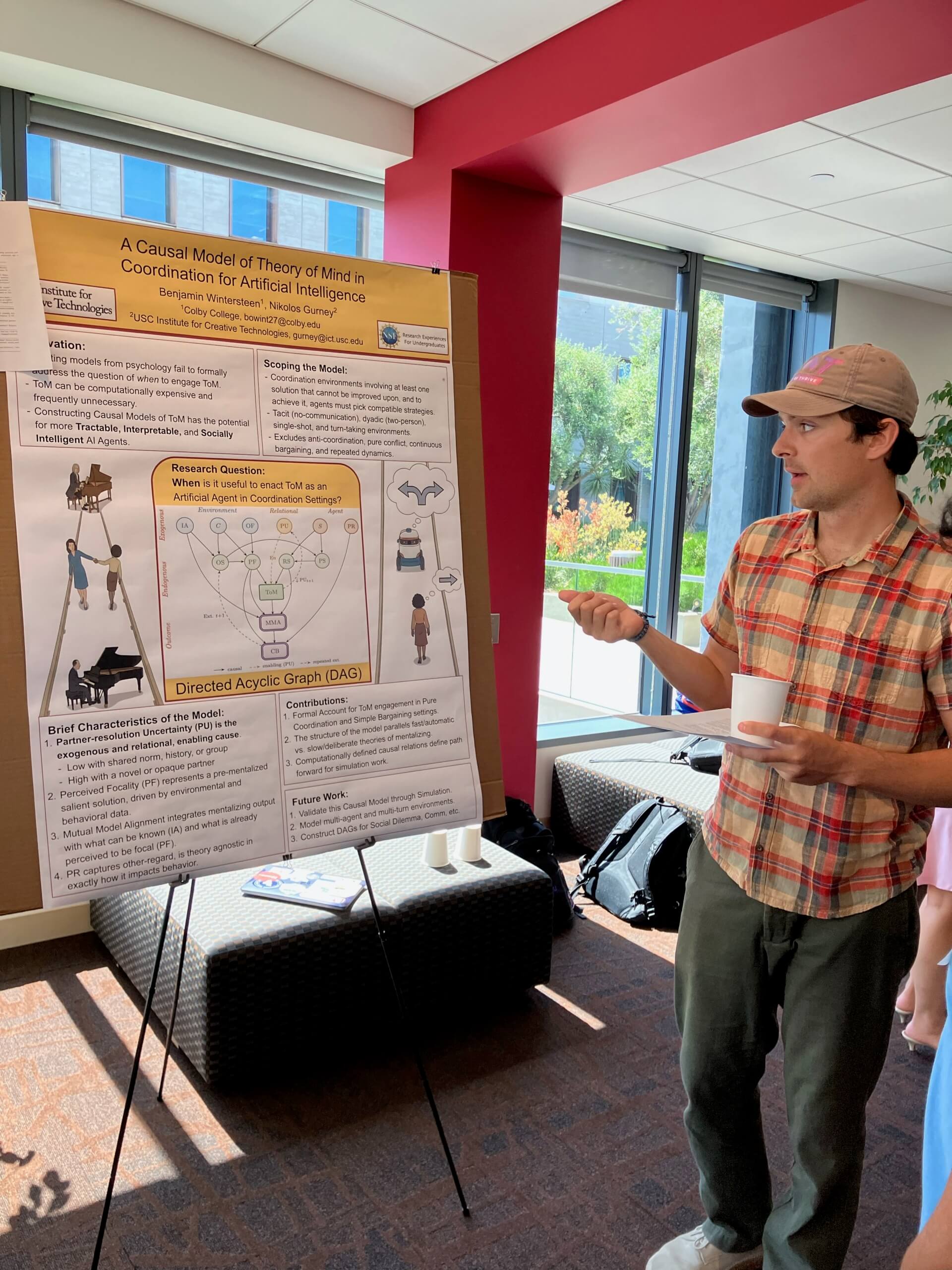
REU students spend more than 90% of the 10-week program working in their assigned labs with research mentors. This year, their projects ranged from modeling social reasoning in AI to developing personalized AI tutors and testing generative models of simulated worlds.
For Benjamin Wintersteen, a philosophy and computer science student at Colby College in Maine, the summer put both fields to work on the same problem. Working with Nikolos Gurney, research lead at ICT’s Social Simulation Lab, Wintersteen developed a causal model for determining when an AI system should use “theory of mind”: reasoning about the mental states of other agents.
Wintersteen was interested in what happens when an AI system tries to coordinate with others while reasoning only from its own perspective. Philosophical ideas about relationships and cooperation needed to be converted into a formal model; this required deciding what the model could represent, and what it would necessarily exclude.
“The most valuable thing I learned was a deepened understanding of what it means to model, recognizing exactly what I am cutting out or including and learning how that impacts outputs,” said Winterstein. The experience strengthened his intention to pursue a PhD and introduced him to possible paths via cognitive and behavioral science.
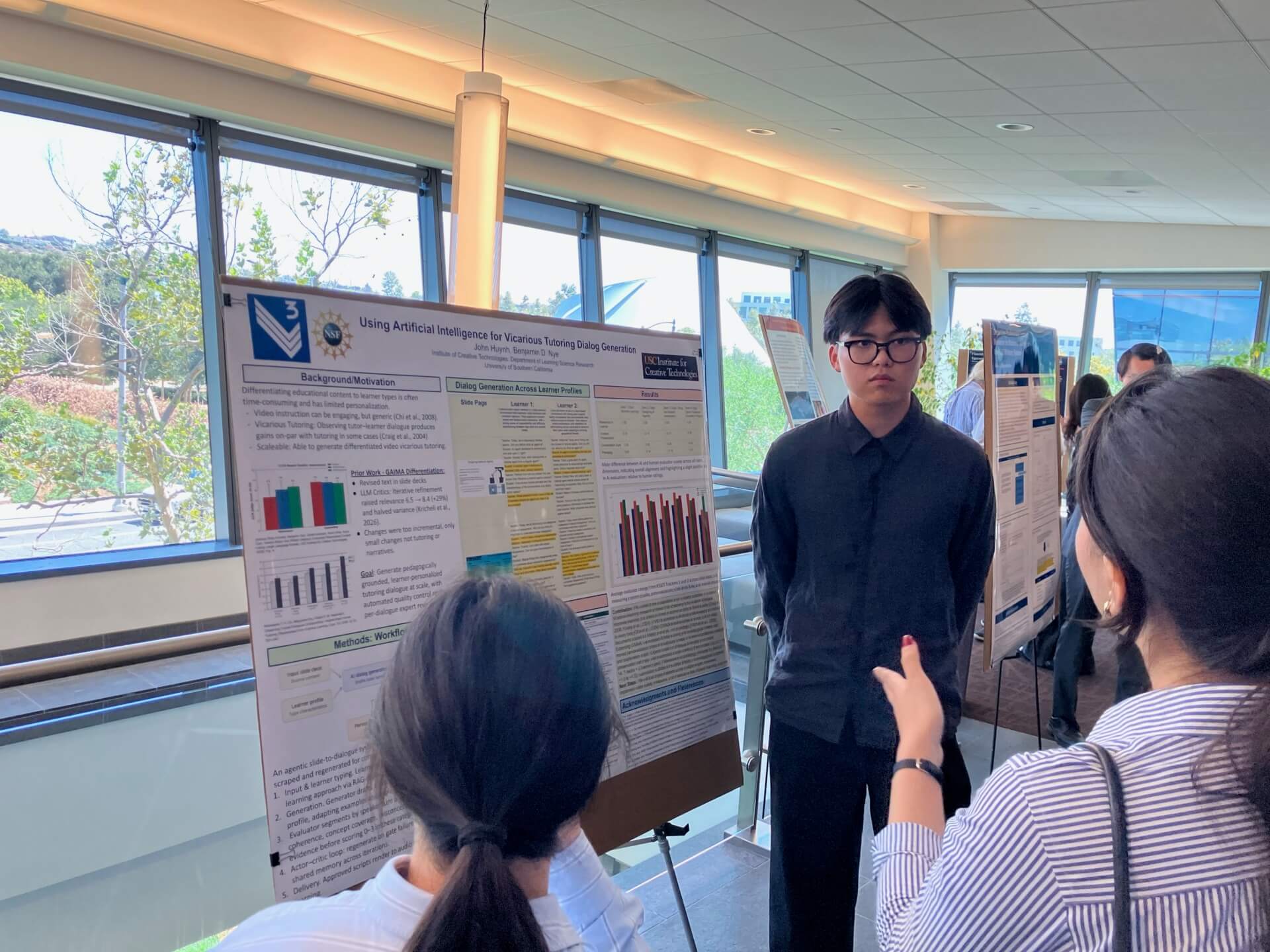
John Huynh presents his research project, “Using Artificial Intelligence for Vicarious Tutoring Dialog Generation”
For John Huynh, who attended Orange Coast College in California before transferring to UCLA this fall, the summer changed how he evaluated an AI system. Working with Benjamin Nye, director of ICT’s Learning Sciences Lab, Huynh developed AI tools that generate personalized educational dialogues and adapt to individual learners. The research looked beyond convincing AI dialogue, focusing instead on whether that dialogue could significantly improve learning.
“I saw how much distance there is between a dialogue that sounds good and one that is measurably effective,” Huynh said.
Testing that difference meant grounding design decisions in research literature, forming hypotheses, evaluating outputs across different learner profiles and combining automated metrics with human feedback. Educational principles such as productive struggle (giving learners appropriately difficult problems) and scaffolding (providing support as they develop new skills) had to become features that could be tested.
“I learned to treat domain expertise as a core component of system design,” said Huynh. He entered the program focused on building technically complex systems; he left more concerned with establishing their effects on the people using them, and with a stronger interest in graduate study and human-centered AI.
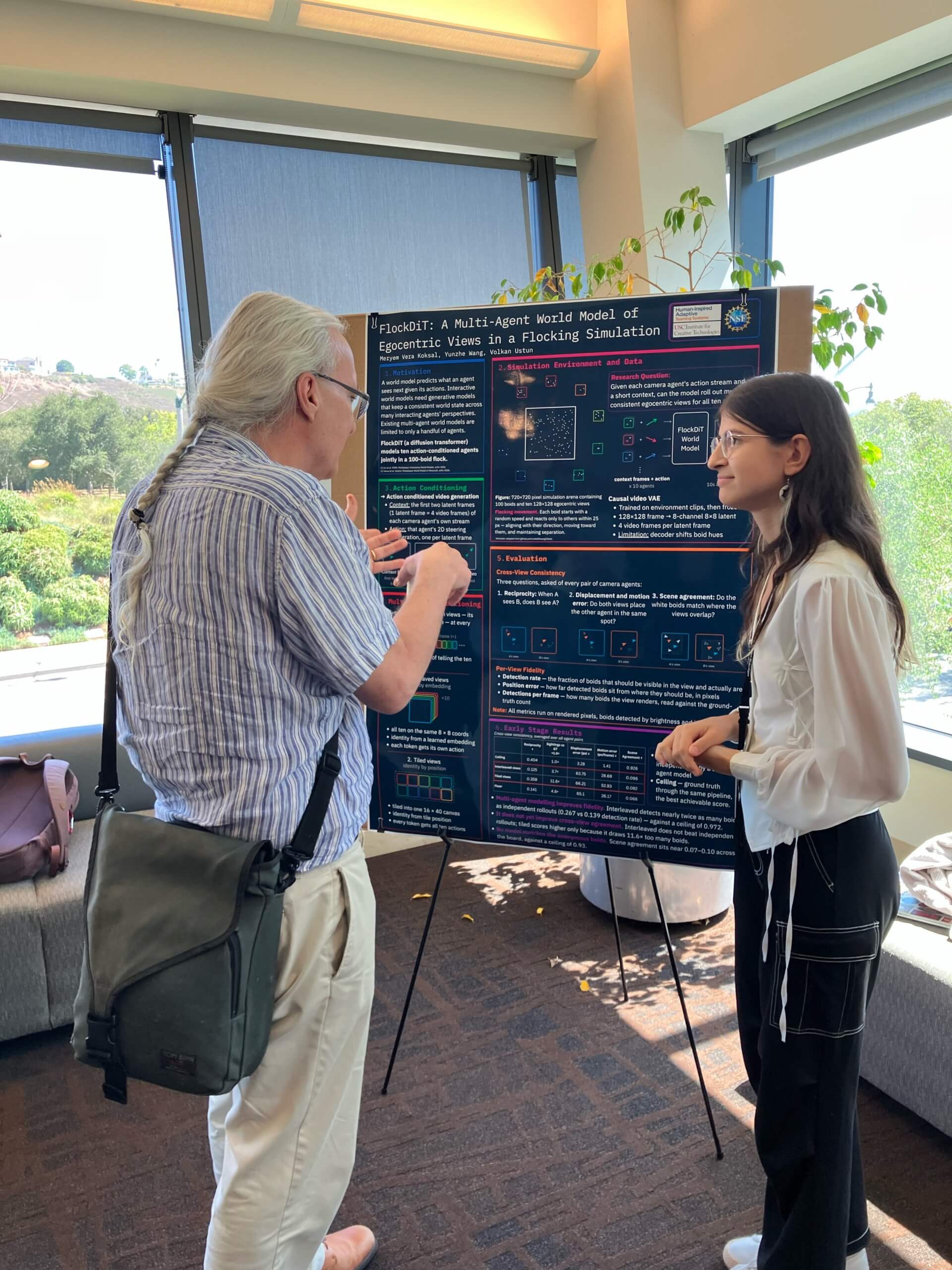
Meryem Koksal presents her research project “FlockDit: A Multi-Agent World Model of Egocentric Views in a Flocking Simulation,” in conversation with Professor John Heidemann
For Meryem Koksal, a computer science student at Grinnell College in Iowa, research meant learning how a project changes as evidence accumulates. At ICT, she worked alongside Volkan Ustun, director of ICT’s Human-inspired Adaptive Teaming Systems Lab. Her project, FlockDit, involved training a generative AI model to produce different agents’ views of the same flocking simulation while maintaining a consistent representation of the larger flock.
“We began with a broad research question, and as we encountered challenges and learned more, we refined the question, methods and experiments that ultimately shaped the project,” Koksal said.
The work introduced her to deep learning, computer vision and video generation while taking her through the research process from reading papers and developing methods to running experiments and evaluating results. Weekly meetings required her to document the work, prepare questions and explain technical problems to her mentors.
Koksal had entered the summer leaning toward industry. At ICT she met David Nelson, director of ICT’s Mixed Reality Lab, whose path from the film industry into virtual and mixed-reality research resonated with her own involvement in acting and theater. “It made me think about the connection between immersive technology and acting,” she said. “Both use storytelling to draw people into an experience and create an emotional connection.” Since taking part in the program, she’s now considering researching world models for games, virtual reality and entertainment.
128 Students, 70 Publications
The program’s publication record indicates how far these undergraduate projects can progress. Across its first 12 years, 128 ICT REU students contributed to 70 research publications. One member of the 2026 cohort had work accepted for publication before this summer’s program ended.
That record is equally important to the NSF. Their REU funding awards operate in three-year cycles and must be renewed; Artstein, who has served on NSF review panels, said reviewers consider both a program’s results and how it plans to develop. The 2026 cohort marked the beginning of the REU’s fifth funding cycle, reflecting both the program’s track record and its continued evolution.
2026 ICT REU Participants
Daniel Amon-Kotey, University of Maryland Baltimore County
Willem De Veirman, Oregon State University
John Huynh, Orange Coast College; transferring to UCLA
Meryem Koksal, Grinnell College
Lauren Lee, University of Michigan Ann Arbor
Jesus Lopez Olivares, San Joaquin Delta College; transferring to University of the Pacific
Nguyen (Syn) Nguyen, California State University Long Beach
Ayla Santos, California State Polytechnic University Pomona
Mayisa Tasnim, Amherst College
Benjamin Wintersteen, Colby College
Sophia Zhang, Wellesley College
Published on September 17th, 2026
Last updated on September 17th, 2026