

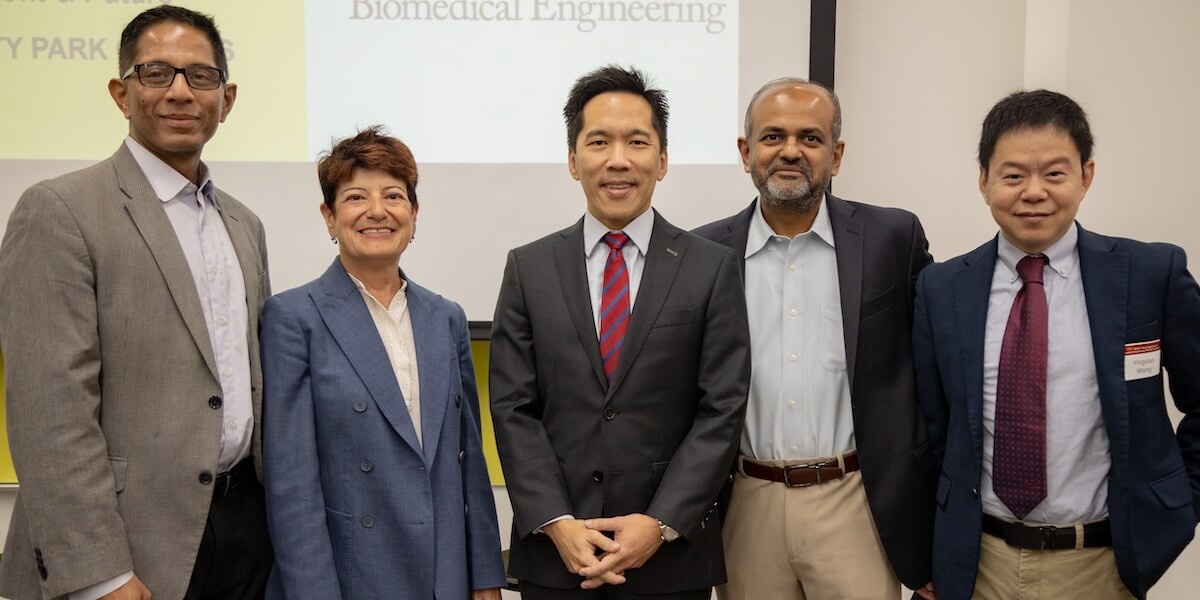
(Left to Right) Shrikanth Narayanan, Vice President of Presidential Initiatives; Dr. Carolyn Meltzer, Dean of the Keck School of Medicine; USC President Beong-Soo Kim; USC Viterbi Dean (Interim) Gaurav Sukhatme; and BME Chair Peter Yingxiao Wang (Photo/Noe Montes)
From developing the first retinal prosthesis approved to restore partial sight to pioneering an implant designed to restore memory, the Alfred E. Mann Department of Biomedical Engineering has spent five decades turning ambitious ideas into technologies that improve human health. Today, that tradition continues through innovations ranging from advanced cancer therapies to sensor-equipped lollipops that could make diagnostic testing more accessible.

USC President Beong-Soo Kim (Photo/Noe Montes)
The department celebrated its 50th anniversary with a two-day gathering honoring its history, its community and its enduring commitment to engineering the future of medicine.
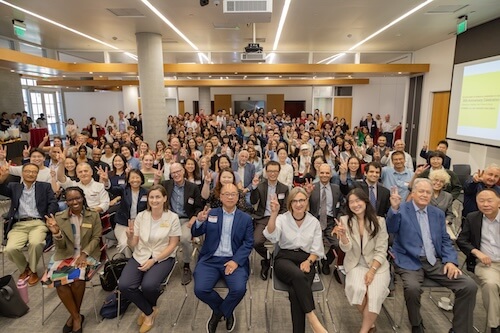
On Thursday, Sept. 3, and Friday, Sept. 4, about 300 USC Viterbi students, alumni, faculty and friends gathered at the USC Michelson Center for Convergent Bioscience to celebrate the department’s past, present and future—and its exceptional students. Since 1983, BME —now jointly administered by the USC Viterbi School of Engineering and the Keck School of Medicine of USC— has produced five USC valedictorians, among the most of any department at the university.
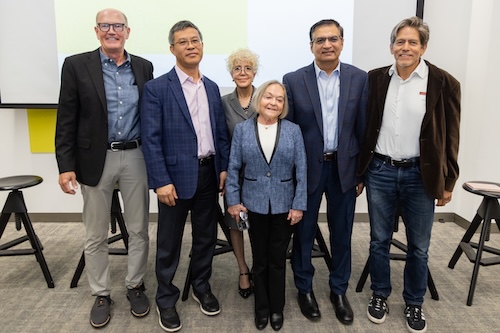
The BME Advisory Board (Photo/Noe Montes)
“I’m so glad so many of you have shown up to celebrate this marvelous event and milestone,” said Department Chair Peter Yingxiao Wang, Dwight C. and Hildagarde E. Baum Chair in Biomedical Engineering and professor of biomedical engineering and molecular microbiology and immunology. “Fifty years is a long time, but every decade this department has answered the same question: How do we turn engineering into something that can reach patients, into something that can reach the bedside? The technologies and tools are constantly changing, but our commitment hasn’t.”

(Photo/Noe Montes)
Added Viterbi School Dean (Interim) Gaurav Sukhatme: “The Alfred E. Mann Department of Biomedical Engineering has a reputation for national leadership. From its earliest days, the department has been interdisciplinary in its reach, bringing key USC faculty together to pursue impactful work.”
[This story discusses the history of biomedical engineering at USC Viterbi (“Building a better department” and “Much to celebrate“), innovative research (“Spotlight on research“), students and alumni reminisces (“All about the students“).Building a better department
As several speakers noted, the department has only grown even stronger more recently.
In November 2022, USC Viterbi received one of the largest naming gifts ever made to a biomedical engineering department. The $35 million gift from the Alfred E. Mann Foundation for Biomedical Engineering honored the late Alfred Mann, who died in 2016. A legendary inventor and businessman, former USC trustee and founder of the Alfred E. Mann Institute at USC, Mann helped develop and support biomedical breakthroughs including a rechargeable pacemaker, insulin pumps and the artificial retina.

Carla Mann Woods speaking at the BME 50th anniversary (Photo/Noe Montes)
“He wanted to invest in technologies in universities where so much amazing science and advancement is occurring,” Carla Mann Woods, Mann’s daughter, a USC alumna and a longtime medical device executive and developer, told the audience. “That’s what he wanted his legacy to be.”
Earlier this year, USC Viterbi and the Keck School also joined forces to form a joint BME department, one of the first of its kind in California. The formal partnership in biomedical education, research, technological innovation and medicine “makes perfect sense as we enter this incredibly exciting period of accelerating innovation and discovery,” USC President Beong-Soo Kim said. “The key is going to be interdisciplinarity and collaboration, and this is going to make it easier.”
Added Dr. Carolyn Meltzer, dean of the Keck School: “I couldn’t be more excited about integrating BME across engineering and medicine. It is at the interface of disciplines where innovation is most rapid. Focusing the unique perspectives of engineers on the most impactful clinical problems to solve is a winning strategy.”
Much to celebrate
In 1963, the late George Bekey, a renowned roboticist who developed the first five-fingered robot, conducted USC’s first biomedical engineering research. Four years later, USC recruited Fred Grodins to launch a biomedical engineering program. He moved quickly, establishing one of the nation’s first biomedical engineering Ph.D. programs in 1969 and undergraduate programs in 1974.
In 1976, as the United States celebrated its bicentennial, USC established one of the nation’s first biomedical engineering departments. Under Grodins’ leadership, it drew on the university’s strengths in electrical and mechanical engineering—and growing recognition that engineering could improve human health. The department soon distinguished itself through the collective excellence of its faculty and students.
Over the next half-century, BME researchers made major advances in biomedical devices and imaging, cellular and molecular bioengineering, and mathematical and computational biosystems.
(Photo/Noe Montes)
Established in 1985, the USC Biomedical Simulations Resource (BMSR) is USC Viterbi’s longest continuously funded NIH research center. Led by Vasilis Marmarelis, David Packard Chair in Engineering and professor of biomedical engineering, and David D’Argenio, Chonette Chair in Biomedical Technology and professor of biomedical engineering, BMSR developed software that played a key role in creating major therapies. Among them were Herceptin, the first biologic approved for breast cancer, and Rituxan, a treatment for non-Hodgkin lymphoma.
In 2013, Professor Mark Humayun’s Argus II became the first retinal prosthesis approved by the U.S. Food and Drug Administration. Two years earlier, Professor Ted Berger’s brain implant became the first medical device in the world to restore lost memory function and strengthen recall.
More recently, researchers from the Alfred E. Mann Department and the Keck School, including BME Chair Wang, used ultrasound to address a key limitation of CAR T-cell therapy, a form of cancer immunotherapy. The ultrasound prompted solid tumors to produce a protein that helped engineered immune cells find and destroy them.
Spotlight on research
On the first day of the golden anniversary celebration, researchers shared their work in four sessions: mathematical and computational biosystems; biomedical devices and imaging; molecular and cellular systems; and neuroengineering.
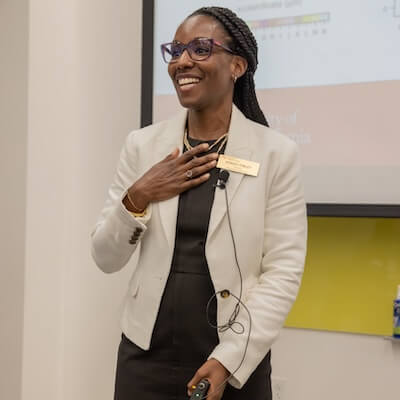
BME Professor Stacey Finley discussed her new breast cancer research. (Photo/Noe Montes)
Stacey Finley, Nicole A. and Thuan Q. Pham Professor and professor of biomedical engineering, chemical engineering and materials science, and quantitative and computational biology, discussed her new breast cancer research. Researchers often try to predict how a patient will respond to cancer treatment based solely on the mix of cells within a tumor. Finley’s research suggests that the cells’ proximity to and communication with one another also matter.
“We’re using modeling to understand the effect of cell-to-cell interactions and how they influence the response to treatment,” said Finley, director of the Center for Computational Modeling of Cancer. “The goal is to develop treatment strategies that exploit those cell-to-cell interactions.”
Ellis Meng, Shelly and Ofer Nemirovsky Chair in Convergent Bioscience and professor of biomedical engineering and electrical and computer engineering, discussed using microfabricated biomedical devices to address clinical needs. She highlighted her efforts to improve shunt technology for hydrocephalus, a neurological condition caused by an imbalance between the production and absorption of cerebrospinal fluid.

BME Professor Eun Ji Chung delivered the welcome remarks. (Photo/Noe Montes)
Physicians now have great difficulty determining when a patient’s shunt has malfunctioned. To address the problem, Meng said, she has spent the past 13 years “building a module with sensors that plugs into a shunt to measure the fluid dynamics of what’s happening inside”—a kind of early-warning system.
Maral Mousavi, Edna Chow and Daniel Maneval Early Career Chair in Biomedical Engineering and associate professor of biomedical engineering, psychiatry, behavioral sciences, pharmacology and pharmaceutical sciences, spoke about her commitment to developing low-cost, easy-to-use diagnostic devices for the home. She discussed creating a finger-stick test that measures lithium in biofluids, including blood and sweat. People with bipolar disorder take lithium to regulate their moods, but too much can cause serious side effects, including kidney damage.
More recently, Mousavi developed the “lolly-lab,” a lollipop that stimulates saliva production and collects the fluid for analysis in the candy’s hollow, sensor-laden stick. “My hope is that these technologies will have a transforming effect in disease management, diagnosis, and really change the patients’ lives,” she said.
Adam Bush, an assistant professor of biomedical engineering at the University of Texas at Austin and a 2017 USC Viterbi Ph.D. alumnus, came back to Troy to discuss the limitations of conventional kidney-function testing. He highlighted his lab’s development of noninvasive MRI techniques that could detect kidney dysfunction earlier and support more precise treatment and transplant decisions.
All about the students
Students took center stage on the second day of BME’s 50th anniversary celebration. They gave presentations, moderated panels and listened intently as alumni in health-related startups, medical devices, biotechnology, academia and the pharmaceutical industry discussed their experiences at USC, career journeys and life lessons.
Collectively, the alumni, including Guangqiang “Jay” Jiang, Ph.D. BME ’05, who sold recently sold his company to Boston Scientific, encouraged the students to stay curious, persevere, become lifelong learners, embrace challenges, learn from failure, give back and draw on the famed Trojan network—and to always, always “Fight On.”
Dominic De La Torre, a senior in biomedical engineering and president of the Associated Students of Biomedical Engineering, or ASBME, spoke about the opportunities he has found at USC. ASBME upperclassmen helped him prepare for an interview with Medtronic, the world’s largest medical device company, where he landed an internship. Members of the student-run professional, academic and social organization also helped him identify his research interests early and taught him how to approach professors about working in their labs. Their guidance paid off, he said. Since his second semester, De La Torre has conducted ultrasound imaging research alongside BME Associate Professor Jesse Tong-Pin Yen.
“I’ve had some success, mostly because of the mentoring and connections I’ve made in ASBME and the biomedical engineering department,” he said.
Megan McCain, BME associate chair and professor of biomedical engineering and stem cell biology, said the students were front and center at the celebration.
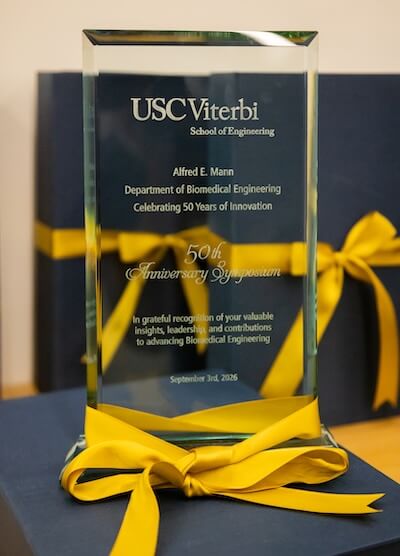
BME 50th anniversary plaque (Photo/Noe Montes)
Soheila Mirhashemi, a member of the USC BME Advisory Board and a successful medical device entrepreneur, credits nearly every step of her career to her Trojan roots. A 1982 BME graduate, Mirhashemi said her mentor, Professor D’Argenio, encouraged her to pursue a Ph.D. and expand the cardiovascular mathematical modeling work she’d begun under his guidance to include the microcirculation. D’Argenio has continued to advise and support her ever since.
That USC network kept paying dividends.
After Edwards Laboratories hired Mirhashemi to work on continuous cardiac output technology, she connected with USC Viterbi alumnus David Chonette, then the company’s president. Chonette later invested in her startup, NeoMedix, which developed surgical equipment for glaucoma and cataract procedures. Mirhashemi went on to license the company’s cataract technology to Bausch & Lomb and sell its glaucoma business to Halma Plc.
Perhaps Mirhashemi’s most meaningful connection to USC BME, though, is personal: her son, David Mittelstein, earned his bachelor’s in biomedical engineering from USC Viterbi in 2013 before going on to earn a Ph.D. from Caltech and an M.D. from Keck. “There is no part of my career that hasn’t been impacted by USC,” Mirhashemi said. “USC has really been the foundation of my career in every way.”
Published on September 11th, 2026
Last updated on September 16th, 2026