

(Image/Midjourney)
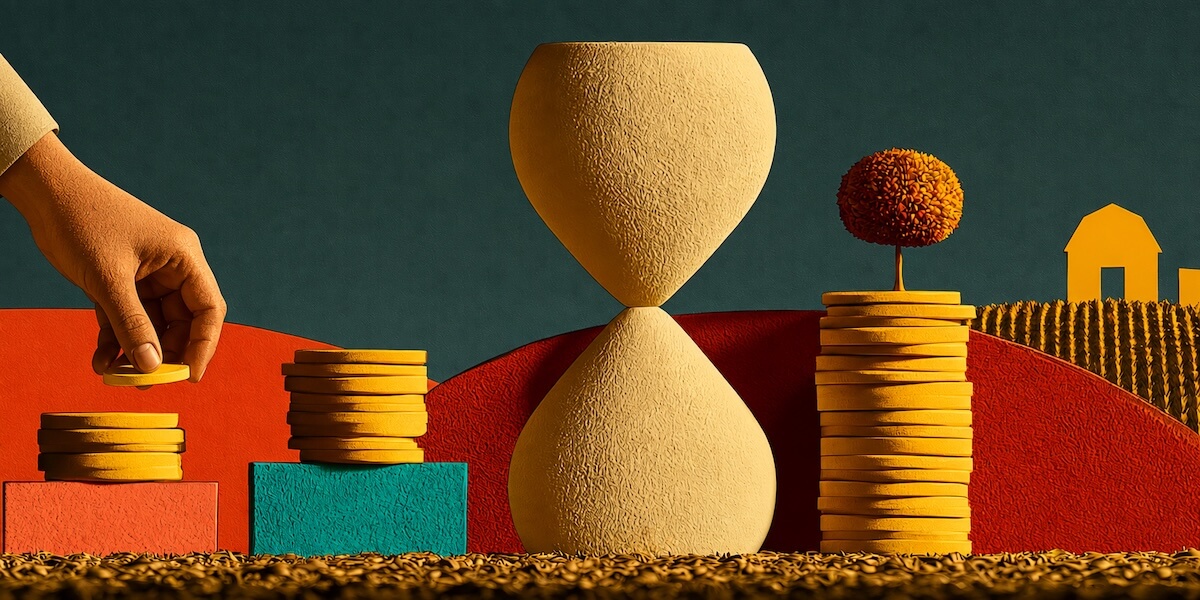
Two friends are preparing to buy a fruit and vegetable farm when a wildfire damages crops and disrupts operations. The farm survives, but it could take years to recover and begin generating the profits they expected. One investor can afford to wait. The other needs her money sooner. Should they reduce her stake? And if so, by what percent? Or should they recruit a more patient partner? Or should they abandon the deal?
For decades, the theory of risk sharing has focused on a person’s willingness to assume risk as the main factor in dividing an uncertain payoff. Ali Abbas, a professor in the USC Viterbi School of Engineering’s Daniel J. Epstein Department of Industrial and Systems Engineering and a professor of public policy at the USC Price School of Public Policy, and co-author Zhengwei Sun, Abbas’s former Ph.D. student now at East China University of Science and Technology in Shanghai, argue that the traditional approach overlooks a crucial difference among investors: Some can afford to wait years for a payoff, while others need their money much sooner.
“An optimal partner in an investment isn’t just determined by their tolerance for risk, but also by their ability to wait for project returns,” said Abbas, who in July received the prestigious 2026 Frank P. Ramsey Medal from the Decision Analysis Society of INFORMS. “The need to have the optimal partners is much more pronounced when time preference comes into play. That was a real surprise.”
Their new framework turns that insight into a practical guide for structuring investments. It can help determine each partner’s stake and share of the proceeds. It might also reveal that a different mix of investors, including someone able to wait longer for a return, could produce a better agreement creating higher value for everyone and save an otherwise promising deal.
Risk Is Only Half the Story
Real estate deals can be upended by fires, construction problems or market downturns. Pharmaceutical companies can spend fortunes developing drugs that never receive government approval.
In each case, the payoff could be years away. That might suit a pension fund investing for the distant future. But for a startup founder who needs money next year, even a promising return a decade from now could come too late. Both might accept the same level of risk, but only one can afford to wait.
Abbas and Sun’s paper, “Risk Sharing with a Time Preference,” published in Decision Analysis, accounts for both. It builds on two earlier works: “Foundations of Decision Analysis,” the 2015 textbook Abbas co-authored with the late Stanford University professor Ronald A. Howard, and Nobel laureate Robert Wilson’s findings in “The Theory of Syndicates”—while also accounting for time preference.
“When you take time preference into account, the classic results need to be modified,” Abbas said.
The new approach calculates what portion of a particular investment makes sense for each partner. It can also show that someone well suited for one deal may be wrong for another if the pay-off is delayed.
When Differences Create Value
Return to the farm. After the fire, turning a profit will take years, meaning an equal split no longer works. The first friend can’t lock up capital for that long, but a smaller 10% share allows her to stay involved without risking money she might need sooner. To cover the rest, her friend can take a larger share, and a third investor can be brought in to fund the remainder. Abbas calculates the optimal share for each partner in this case, and shows how having the right partner creates value for everybody involved.
“Instead of giving up the investment, people who are able to wait can take a higher percentage, while those who need their money sooner can take a much smaller share,” Abbas said. “That way, we don’t let the investment go away.”
By changing the ownership shares, the three investors can keep the purchase alive despite their different financial needs. What might have ended the deal instead becomes the key to making it work.
That can produce a fairer agreement because no partner takes more risk or waits longer than makes sense. It does not guarantee a larger return. It creates value by matching each stake to that investor’s circumstances.
The findings could benefit venture capital firms, startup founders, real estate partnerships, pension funds and pharmaceutical companies. Abbas was surprised that even small differences in patience could sharply alter the best division of a future payoff.
Moving From Theory to Deals
Before the approach can gain traction, investment firms must change the questions they ask customers.
Many classify clients as having high, medium or low risk tolerance. Even fewer measure how much someone values money today compared with money years from now. Such labels are not precise enough to determine each investor’s best share, Abbas said.
Some venture capital firms may apply the findings quickly. Abbas hopes USC can offer seminars showing investors how to measure risk and patience and use the results in actual deals.
“This isn’t just an academic exercise,” said Abbas, whose research has influenced engineering design, public policy, homeland security, and risk management. “It is something that I believe can add a lot of value to partnerships and to venture capitalists. And I hope the results are spread out.”
Published on November 4th, 2026
Last updated on November 4th, 2026