


Mohammed Al-Suwaiyel, M.S. ’75, Ph.D. ’79, one of the first university professors to teach computer science in the Saudi kingdom, influenced an entire generation of current Saudi leaders. Photo illustration by ChatGPT.
Mohammed Al-Suwaiyel’s family never knew what to give him.
Birthdays and special occasions were hard. According to his son, Ibrahim, when his father was named minister of telecommunications and information technology for Saudi Arabia, “We begged him, practically begged him…tell us what gift we can get you. And he always gives us a hard time.”
Mohammed’s response: “Whatever you get me, I’ll be happy with.”
“Our father,” Reem Al-Suwaiyel, one of his six daughters, noted, “is not very materialistic.”
Finally, Ibrahim, his sisters and their mother, Ibtisam, hatched a plan during Ramadan in 2024. They had decided on a perfect gift.
They gave him a letter.
It was from his alma mater, the USC Viterbi School of Engineering, announcing a brand-new, robotics laboratory. The Dr. Mohammed Al-Suwaiyel Computer Science Laboratory, to be precise, on the third floor of USC’s Ginsburg Hall, home of the equally new USC School of Advanced Computing.
Mohammed, according to his family, doesn’t usually betray strong emotions. This time was different.
Said Ibrahim: “To see the reaction on his face when we gave him that piece of paper, I can tell you, hands down, that was the second-best moment of my life — second to my son’s birth.”
For Mohammed, M.S. ’75, Ph.D. ’79 — who was among the earliest Saudi Arabian graduate students in computer science in the USC Viterbi School of Engineering — it was the next chapter of a Trojan story that began over 50 years ago.
“He always talked about USC,” said Reem, “his experience, his old days and good memories he had there. He likes to give back to society, to people, to help others. So, Ibrahim came with this idea, and we all supported it.”

On left: Mohammed and (his wife) Ibtisam Al-Suwaiyel in the U.S. in 1975; on right: a recent portrait of his friend and Ph.D. advisor, Ellis Horowitz, USC Viterbi professor emeritus of computer science.
Breaking Barriers: A Half Century Friendship
Mohammed, who grew up in Al-Mahad, a small gold mining town in western Saudi Arabia, remembers reading Mark Twain stories about the great California gold rush. His beloved father, in fact, became like a sheriff of the small town — Mohammed likens him to a Saudi version of Andy Griffith.
But in the 1970s, another gold rush was happening, also situated in California: the modern computing boom.
In 1971, the Intel 4004 Microprocessor burst onto the scene, proving that an entire computer processor could be miniaturized and mass-produced cheaply. In 1975, the Altair 8800, widely considered the first commercially successful personal computer, debuted on the cover of “Popular Electronics” magazine. A year later, Apple Computer was founded.
And yet, it was a lab accident that led him to computer science.
Mohammed originally loved chemistry and intended to pursue it. However, in his final organic chemistry lab — while preparing aspirin from tea leaves — a test tube broke in his hand, requiring four stitches.
He told his professor, “No more chemistry for me,” and switched to a major with “no glass lab,” which happened to be computer science.
While at USC, Mohammed joined a small cohort of other Saudi graduate students. Over 50 years later, he speaks with great respect for his professors at USC, many of whom were Jewish, including Edward Blum, Seymour Ginsburg and above all, his Ph.D. advisor, Ellis Horowitz.
He fondly remembers him and his young wife, Ibtisam, being invited into the Horowitz home for meals. Shared kosher food was a source of bonding. One of Mohammed’s favorite places in L.A. was a kosher grocery store on Fairfax Avenue, and the knowledge of a pork free, home cooked meal with Professor Horowitz was always a blessing.
Later, Mohammed and Ibtisam would return the favor, inviting Horowitz and his wife to their little apartment on the USC campus.
Said Mohammed: “Now, people, when I tell them this, they say, ‘How come you’re a Muslim with a Jew?’ I said, ‘There is absolutely no problem with this.’ Because you probably know, this Muslim-Jew thing is a new creation. As a Muslim, I have to believe in Moses and Jesus and their scriptures.”
According to Horowitz, “Despite the obvious tensions in the Middle East, we concentrated on the science, and politics was never discussed. The computer science department was like neutral ground, and the thing we had in common was the search for new technology to aid people.”
“Neither of us smoked or drank alcohol and we both were married and valued family, so our personalities were well aligned,” Horowitz added.
Several years after Mohammed’s 1979 graduation, he invited his professor to Saudi Arabia. Horowitz stayed for one week, giving lectures and talking to many Saudi Arabian faculty members about computer science.
“He was a wonderful host and feted me at home on multiple occasions,” Horowitz said, noting his travels from Jeddah to Riyadh.
Neither man ever forgot the friendship.
Open Door Policy: Shaping Modern Saudi Arabia

Mohammed Al-Suwaiyel (center) during a visit to Alfaisal University in 2024.
Mohammed still embodies that spirit of open-ness he saw modeled at USC. First, as a professor and dean of the Computer Science and Engineering College at King Fahd University of Petroleum & Minerals (KFUPM). Later, as president at King Abdulaziz City for Science and Technology (KACST), the Saudi equivalent of the U.S. National Science Foundation. And finally, as a leader in the Saudi government, the appointed minister of communications and information technology from 2015 to 2017.
He refers to it as his “open door policy.”
“I have to respect them before they respect me,” said Mohammed. “In my professional life, I never closed my door, my office door. Not as a professor or dean or minister.”
One day, for example, as a cabinet-level minister, Mohammed heard an old lady complaining to his office director. He couldn’t hear her very well, but he knew she was unhappy.
After Mohammed insisted on meeting with her, he learned that her phone had been disconnected for the past eight months, and she was still getting a bill. In response, he offered the woman some water or tea and promptly called the CEO of Saudi Telecom, who happened to be his former student. A refund was issued immediately.
Later, an elderly man, who had traveled over 1000 kilometers from a very remote village, was angrily shouting outside his office. Mohammed helped the man and gave him his phone number: “Call me. Don’t travel 1000 kilometers!”
“People look at me sometimes as the crazy minister,” Mohammed laughs, noting that at a time when he was expected to attend official meetings with a personal driver and a secretary, he’d rather drive himself in his 1996 Jeep Wrangler.
His time in government coincided with a remarkable period of transformation in the Saudi technology sector: the transition from a state telecommunications monopoly to a private marketplace.
In 2003, as the governor of the telecom commission, Mohammed had the unenviable task of convincing the Saudi Telecom Company, STC, to allow new competitors.
Like any good professor, he made an academic analogy. He told them: “If we’re two students in a class, you’re an A student, and you see a new guy in town coming, competing with you, you’ll try to do better.”
“STC grew many folds. And the competitors grew. And the real winner is the consumer.”
Today, many of his former students and colleagues are Saudi ministers and leaders, including an ex-minister of education.
Said his son, Ibrahim: “My father was one of the first Saudis to teach computer science in the university. Most of the people who started their career in the mid ’80s to ’90s, who are leaders of the country, interacted with my father in one way or another. He’s one of the greatest people I’ve ever met, the greatest teacher.”
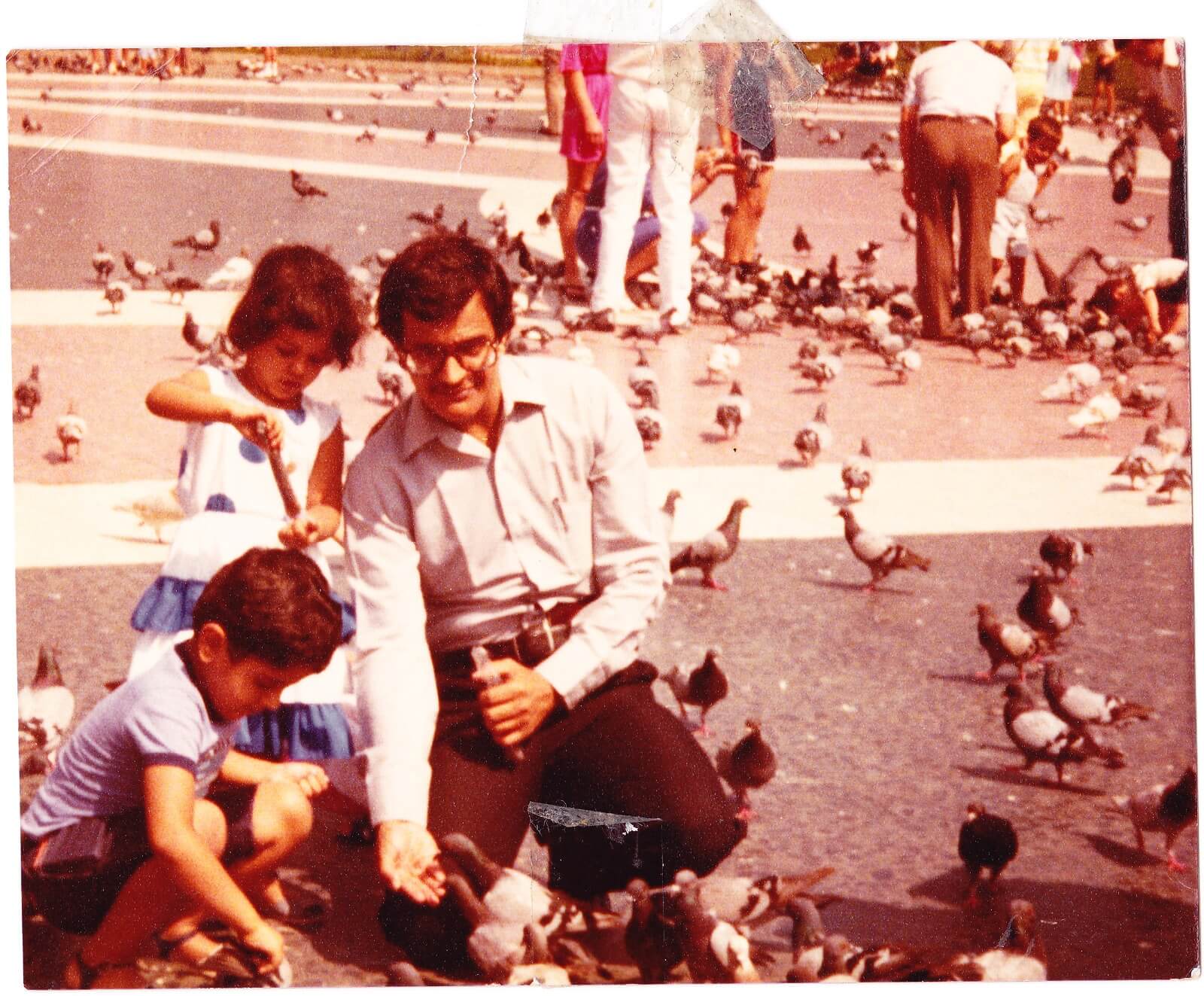
Mohammed with his son, Ibrahim, and eldest daughter, Rasha. Submitted photo.
Al-Suwaiyel Lab: “What did we teach you here?”
When Mohammed thinks about having his name on the Al-Suwaiyel Lab, he reflects: “It’s good that I came to USC; and that I left part of me at USC.”
“This is a rare honor,” he said, and smiles. “I try to imagine when people look at this lab with this name, they might say, ‘Who is this guy?’”
So indeed, who is this guy? The man, who as Mohammed puts it: “has a very long name that some may not even be able to pronounce.”

Opening on September 17, 2024, the Dr. Allen and Charlotte Ginsburg Human-Centered Computation Hall (left) is the new home for the USC School of Advanced Computing. The 116,000-square-foot building includes new AI and robotics laboratories, including the Dr. Mohammed Al-Suwaiyel Computer Science Laboratory.
For sure, he’s a man that would be at home with the potentially dozens of languages spoken in Ginsburg Hall. He himself speaks five languages, including Arabic, English, French, Spanish and Chinese. Indeed, one of his earliest childhood memories, back in his tiny gold mining town, was about language.
He still remembers visiting the old mining camp, abandoned by the Saudi Arabian Mining Syndicate in 1954, exploring the empty houses where the foreigners had lived. Their library was in disarray with books scattered everywhere. It was a moment of recognition for young Mohammed: “there must be another language beside Arabic.”
He’s a man uncommonly concerned with decency. As his daughter, Reem puts it: “He is the kindest man.”
He’s a man who loves “The Flintstones” and “Tom and Jerry” cartoons (“I watch them early in the morning”); he’s a man that, as a professor, loved riding his bicycle around King Fahd University campus with his son, Ibrahim.
He’s a man fascinated by the history of secret codes, which is perhaps unsurprising given his delight in foreign languages. Mohammed has given talks and funded research that verified historian David Kahn’s theory that modern cryptology was “born among the Arabs.” This support led to the discovery of 15 original manuscripts in France and Turkey, which, once translated, “changed the face of history of cryptography” and “pushed it back 500 years.”
He’s a man who has bridged two Saudi Arabias — the one where his father rode camels and walked hundreds of miles to his destination; and the modern one, that he played a role in shaping — one that, for example, ranks second among all G20 countries on the Telecommunication and Technology Development Index.
He’s a man that is unstintingly optimistic about the future — something that he has drilled into his seven children. Indeed, whenever he experiences moments of doubt, he likes to return to the wisdom of his old friend and mentor, Professor Horowitz.
He remembers standing nervously outside the room in which the Ph.D. committee deliberated over his thesis. Finally, Horowitz emerged, greeting him as “Dr. Mohammed.”
His student, having never been addressed this way, looked around.
“Who… who is this Dr. Mohammed?”
“You,” Horowitz said.
Then, after a pause, Horowitz asked: “What did we teach you here?”
Mohammed began to recite some of the research they had done in fast algorithms, but Horowitz interrupted him.
“No, no, no, no,” he said. “What we taught you here, is how to learn. Just keep learning.”

Yannis Yortsos (left), dean of the USC Viterbi School, visits Mohammed Al-Suwaiyel at his home in December 2023.
Published on November 24th, 2025
Last updated on November 24th, 2025