

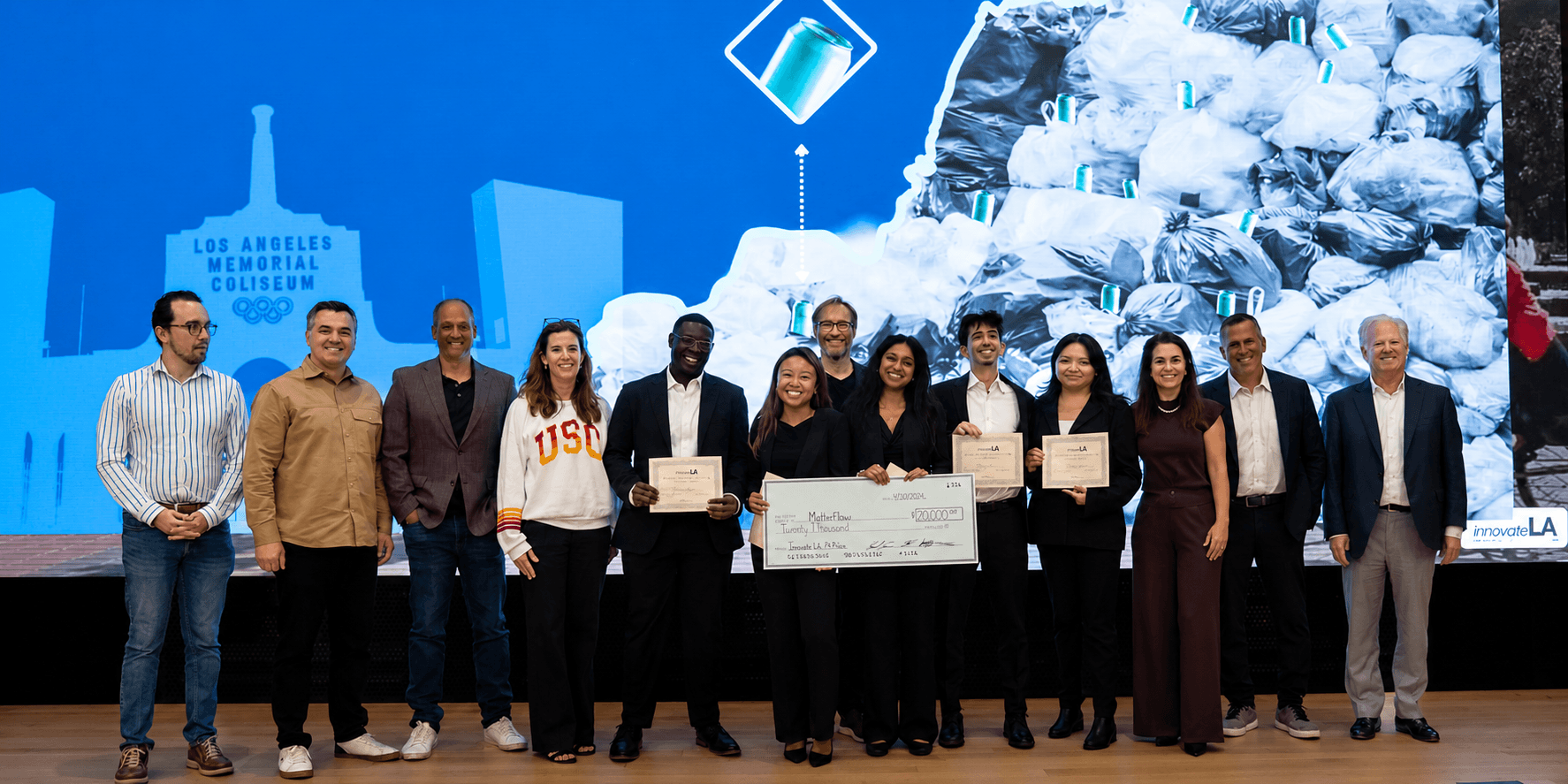
Team MatterFlow with the judging panel and organizers of the Das Family Innovate x LA Competition
Shortly after winning the hackathon at The Games Week: Building LA28 (2-6 March), Team MatterFlow shared their tips on how to craft a persuasive business pitch.
The problem they were tackling? The inefficiency of waste sorting at large venues. Their solution? An automated system that uses computer vision and mechanical sorting to recover valuable materials while generating a feedback loop of data.
Given that MatterFlow were soon due to compete at the annual Das Family Innovate X LA Competition held by USC Viterbi’s Sonny Astani Department of Civil & Environmental Engineering, you might have thought they’d keep their winning strategies under wraps.
But perhaps they had an intuition of what was to come.
Winning the Games Week hackathon had been MatterFlow’s first taste of seed funding; a nice nudge of $1000. On 30 April, when the winners of the Das Family Competition were announced by the panel of judges, the team gathered on stage once again to receive a super-size check: a booster of $20,000 to invest in the company.
Civil, environmental, entrepreneurial

L-R: Cassius Palacio, Ishaani Pradeep, Salma Setia, Aiden Pushin, Claudia Zambrano
What makes the Das Family Competition different from other college innovation initiatives? Established in 2022 with the generous support of CEE alumni Santanu Das and Kelly Das, the competition is one of the few to focus specifically on student entrepreneurship in the context of civil and environmental engineering education.
Undergraduate and graduate students from across USC are encouraged to take part, combining diverse skillsets from business strategy to data analysis, from behavioral science to electrical engineering. Each team is typically anchored by a member of CEE, and business concepts are targeted to tackle urban and environmental challenges impacting Los Angeles – solutions both specific and designed to scale.
From the kick-off in the fall semester to pitch day in the spring, teams brainstorm ideas and receive mentorship from CEE faculty, alumni, and external speakers, a learning environment that essentially functions as a startup incubator.
This year’s judges were a panel of USC alumni, each invited for their expertise in envisioning, financing, or marketing civil and environmental engineering innovations: Daniel Druhora, filmmaker and educator; Brandon Blaylock, co-founder of Faros Infrastructure Partners and Mexico Infrastructure Partners; Derick Roselli, ’94, executive director at J.P. Morgan Private Bank; and Oscar A. Neyra, strategic director of transition at ADAC-ARCTIC and partner manager of USC Viterbi Technology Innovation and Entrepreneurship.
For Burcin Becerik-Gerber, Fred Champion Chair in Civil and Environmental Engineering and professor of civil and environmental engineering, the Das Family Competition is a direct expression of the department’s entrepreneurship ethic; the shared understanding among students and faculty that classroom concepts have the potential to be converted into effective solutions. The themes of CEE’s strategic vision serve as a map for key areas of impact: engineering for disaster resilience, extreme habitats, environmental stewardship, transport service systems and urban livability.
“Why is it important to establish a competition like this in an academic context, specifically from within the Sonny Astani Department of Civil & Environmental Department at USC Viterbi?” said Becerik-Gerber in her opening remarks. “These ideas are coming from people who are deeply grounded in these problems and systems. They understand the constraints, the stakeholders and the consequences. That’s what makes this competition so unique, and why our students so often go on to become change-makers.”
Who would you choose?
Competition pitches for 2026 range from innovations in recycling and circular material systems to clean energy, transportation, water and energy systems, and worker safety. Each addresses a real problem with real constraints, necessitating new thinking, new approaches and practical solutions.
If you were on the judging panel, which team would you choose? Follow the link in each team’s title to like their post on the CEE LinkedIn page:
MatterFlow
Ishaani Pradeep (Biomedical Engineering), Aiden Pushin (Civil Engineering, Construction Management), Salma Setia (Health Promotion & Disease Prevention), Claudia Zambrano (Civil Engineering), Cassius Palacio (Architecture)

1ST Prize: $20,000
In the process of sorting waste after events at major venues, aluminum is frequently lost in mixed waste streams because sorting depends on small back-of-house teams working under time pressure. This becomes especially critical in Los Angeles ahead of the LA28 Olympic & Paralympic Games, where the city is expected to process waste volumes equivalent to seven Super Bowls per day. In this setting, those teams ultimately decide whether materials are recovered or sent to landfill, even though much of the waste stream remains recyclable.
MatterFlow responds with a deployable unit that intervenes directly in this process. Using computer vision, the system identifies aluminum within mixed waste while mechanical paddles remove it in real time, reducing reliance on manual sorting. It also produces a digital audit of material flow, enabling venues to track recovery and generate compliance data required for state legislation and certification standards. The unit is designed to integrate into existing operations, with a confirmed deployment at the LA Coliseum ahead of LA28.
The impact centers on standardization and scalability. If proven at the Coliseum, the same model can extend to festivals, stadiums and other venues managing high volumes of event waste. This shifts recovery from a manual, capacity-limited task into a repeatable system embedded in infrastructure, increasing diversion rates while helping venues meet regulatory requirements.
The judges selected MatterFlow as the winner, citing a socially grounded idea with a clear path to implementation, a team they trusted and a pitch that made the project feel both impactful and achievable.
RE-LEV
Alnur Askar (Business, Santa Monica College), Sarah Lee (Industrial and Systems Engineering), Seth Moberg (Public Policy, Santa Monica College)
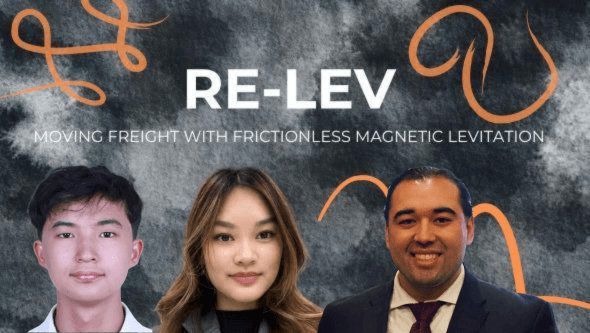
Runner up: $10,000
Freight movement across the United States is constrained by aging diesel rail systems and heavily burdened corridors, particularly along routes like the Alameda Corridor, which carries 15% of all U.S. goods. As demand continues to rise, existing infrastructure struggles to keep pace, leading to congestion, delays and operational inefficiencies. These pressures are most visible near logistics hubs such as the Port of Los Angeles, where bottlenecks create heavy diesel truck traffic, noise pollution and slower delivery timelines.
RE-LEV addresses this limitation by retrofitting existing freight rail corridors with magnetic levitation technology. This allows trains to move faster, more efficiently and more quietly without requiring entirely new rail systems. By building on existing infrastructure rather than replacing it, the approach reduces both cost and implementation barriers while improving performance along critical freight routes. The focus is on upgrading transport within corridors already central to national logistics networks.
The impact is a measurable improvement in system performance. Increased speed and efficiency reduce port congestion, lower transportation costs and decrease reliance on diesel-powered freight. This also contributes to lower emissions, quieter corridors and stronger supply chain resilience. By enabling current infrastructure to handle growing demand, RE-LEV creates a scalable path for expanding freight capacity without rebuilding entire networks.
Charged
Sam Gold (Environmental Engineering), Joel Aziangli Etchri (Mechanical Engineering), Giselle Orozco (Business Admin), Sam Kovar (Business Administration), Keira Izumi (Mechanical Engineering), Hannah Goldstein (Mechanical Engineering)
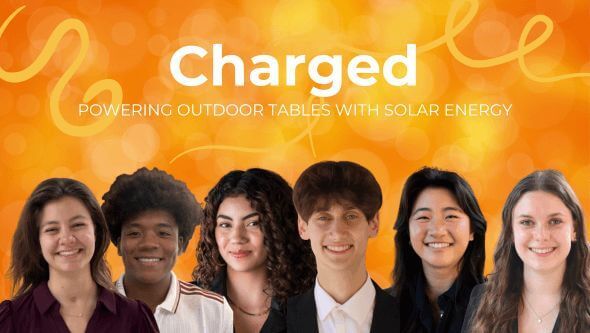
Audience Choice
Public space in Los Angeles is constrained by limited access to power, shade and connectivity, particularly in high-traffic areas such as university perimeters, corporate campuses and transit hubs. As the city prepares for a major influx of visitors during LA28, these gaps become increasingly visible. People who need to work or charge devices are often pushed indoors due to digital dead zones and the absence of powered outdoor seating, creating a disconnect between outdoor environments and functional needs.
Charged addresses this by introducing high-capacity, solar-powered outdoor workspaces that provide both shade and reliable energy access. The system operates entirely on solar power while supporting consistent high-density usage within a compact footprint. By placing this infrastructure directly in outdoor settings, users are able to remain outside while maintaining access to power for devices and work.
The impact is the development of a distributed network of powered outdoor spaces that expands access to connectivity across the city. This reduces reliance on indoor infrastructure for energy needs and activates underused public areas as functional, tech-enabled environments. In Los Angeles, the model supports both residents and large-scale event audiences while contributing to digital equity and improved use of public space.
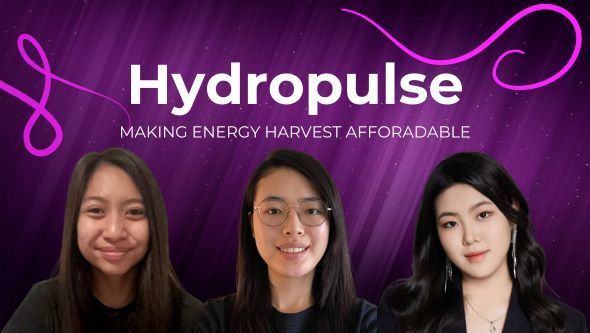
Hydropulse
Jenny Nguyen (Civil Engineering), Kaylee Kim (Mechanical Engineering), Zihe Jiang (Mechanical Engineering)
Urban water systems consistently lose usable energy through pressure regulation. As water moves through high-pressure networks, excess pressure is dissipated as heat at pressure-reducing valve stations, especially in areas with elevation changes or dense infrastructure such as hospitals, industrial facilities and university campuses. This process occurs continuously within existing systems but remains largely unseen because it takes place underground or within utility infrastructure, resulting in ongoing energy loss.
Hydropulse addresses this inefficiency by replacing pressure-reducing valves with a standardized pump-as-turbine system that captures this wasted energy and converts it into electricity. Operating within existing water networks, the system uses continuous water flow to generate power without requiring new land or additional infrastructure. Its integration into current systems allows energy generation to align with existing layouts and operational constraints.
The impact is the transformation of water infrastructure into a distributed energy source. By recovering energy that would otherwise be lost, the system reduces energy costs for facilities such as hospitals, universities and utilities while contributing to cleaner power generation. More broadly, it introduces a model where existing infrastructure is used more efficiently, increasing resilience and expanding the role of urban systems in energy production without new construction.
Hubl
Aagam Jain (Electrical and Computer Engineering), Deacon Larson (Finance), Hansi Lee (Electrical and Computer Engineering), Taehyung Kim (Civil Engineering), Jack Miller (Mechanical Engineering)

Transportation to and from large events is constrained by simultaneous demand from tens of thousands of attendees, particularly at the end of concerts, games and festivals. Existing options such as rideshare and personal vehicles lead to surge pricing, long wait times, heavy congestion and limited late-night transit availability. The challenge lies not only in arrival but in the concentrated exit, when large volumes of people attempt to leave at once and overwhelm transportation systems.
Hubl addresses this through an event transportation platform that uses dynamic routing to coordinate shared shuttle services. Riders are grouped by location and assigned to designated pickup hubs, organizing demand into efficient group movements rather than individual trips. This reduces reliance on single-occupancy vehicles and offers a structured alternative to rideshare, with routing designed specifically for high-volume event conditions.
The impact is a shift in how transportation is integrated into events. Allowing attendees to book transportation alongside their tickets reduces the number of cars on the road, easing congestion and lowering emissions. It also improves reliability and safety by reducing late-night driving and unmanaged demand spikes. At scale, this introduces a coordinated model for high-volume mobility where shared transport replaces fragmented individual travel.
Harvi
Natalie Lopez (Environmental Studies and Integrated Design, Business, and Technology), Arian Tomar (Film and Television Production), Pagnapech Chamroeun (Electrical and Computer Engineering), Evelyn Zhong (Emerging Transportation Systems), Bakytzhan Baitassov (Construction Management)

Outdoor workers face a defined safety risk linked to inadequate hydration in high-heat environments. Construction workers account for 36% of heat-related workplace fatalities while representing only 6% of the workforce, and current hydration methods rely on bottled water systems that are inefficient, costly and unreliable. In regions such as Southern California, rising temperatures and prolonged exposure on construction sites, agricultural fields and dense urban areas increase the likelihood of heat-related illness, while consistent access to quality drinking water remains limited.
HARVI addresses this issue with a deployable air-to-water system that produces clean, electrolyte-enhanced drinking water directly on-site. By generating water at the point of use, it removes the need for bottled water logistics and ensures a continuous supply for workers in high-temperature conditions. The system is designed for reliability and scalability across outdoor job sites where hydration access is inconsistent.
The impact is a change in how hydration is delivered in heat-exposed environments. On job sites, HARVI reduces dependence on plastic water distribution and removes the need for restocking while improving access to electrolyte-enhanced water. This directly targets the reduction of heat-related injuries. At a broader level, the system can extend to disaster relief and remote settings, expanding access to on-site water generation where traditional supply chains are limited.
Learn more about the Innovate x LA: Das Family Student Competition here
Published on May 12th, 2026
Last updated on May 12th, 2026