

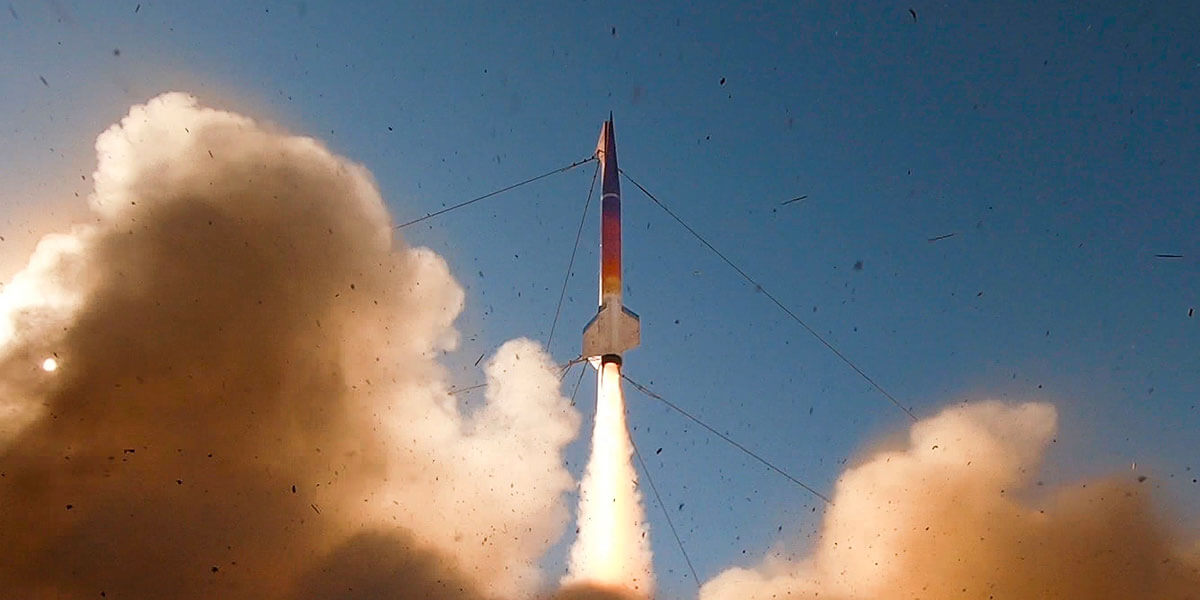
Malibu launches with payload CHASER from Reaction Research Society’s test site in the Mojave Desert
On October 18, USCRPL launched and recovered their experimental 6-inch vehicle, Malibu, built to test several new elements of rocket design. Most significantly, Malibu conveyed USCRPL’s first ever payload capsule, CHASER, consisting of a camera and avionics unit.

The USCRPL prepares to launch Malibu
Malibu reached an altitude of 46,350 feet and is USCRPL’s first flight vehicle since the landmark achievement of Aftershock II (October 2024), which broke the international amateur space record at an altitude of 470,000 feet.
To test recovery, avionics and sensor integration methods, CHASER was released from the rocket and then recovered independently with its own parachute. CHASER’s integrated cameras were able to capture footage of Malibu’s descent.
Malibu’s other experimental features include the use of two parachutes (“dual deployment”) to reduce the speed of the rocket for more controlled descent. A new cored fin design applies a sandwich panel composite design, reducing the mass of the fins by 40%.
“This launch could not have performed better,” said Sofia Pantoja, USCRPL executive engineer. “Every project performed as designed, and we were able to have one of the smoothest recoveries I’ve ever seen during my time at USC.”
The launch took place at Reaction Research Society’s Mojave Test Area in Kern County, CA. Weather conditions were challenging – high winds meant that the rocket was at risk of landing where it couldn’t be recovered.

Image of Malibu’s descent captured by CHASER’s camera
“We dealt with a very tight timeframe and had no room for errors,” said Pantoja. “But we were able to get the job done and are now able to focus on scaling up this project for a spaceshot launch next semester.”
The spaceshot slated for April 2026 will aim to break the altitude record set by Aftershock II, which in turn broke the record held by Traveler IV (April 2019), the first entirely student-designed and built rocket to pass the Kármán line (the boundary between Earth’s atmosphere and outer space).
The features successfully tested via Malibu will advance the design of a rocket similar to Aftershock II. The new rocket will feature a payload, cored fins and dual deployment.
“The goal is to reach an even higher launch altitude than we have ever reached before, hoping to closely reach the legal limit of 491,000 ft,” said Pantoja. “With this next flight we will prove our ability to consistently return to space – with ever lighter, more economical, and more reliable rockets, carrying ever more ambitious payloads.”
Published on November 4th, 2025
Last updated on November 4th, 2025